
Decode Edmonson County Property Tax Records
More than one office produces Edmonson County property tax records. The Property Value Administrator finds and values taxable real property. Taxing authorities set the rates. Collection records show the bill and whether it was paid. The County Clerk takes over once an unpaid bill moves into the delinquent-tax process. Attach the assessment year to every figure you compare. Otherwise, a current bill ends up matched against an older value on the tax roll.
| Field | What It Shows | Where |
|---|---|---|
| Fair cash / assessed value | The PVA’s value for the applicable assessment year | Edmonson County PVA roll |
| Land and improvements | Components of the parcel value if displayed | PVA parcel record |
| Exemption | A qualifying reduction reflected in taxable value | PVA and Kentucky Revenue guidance |
| Bill and payment status | Charges, dates, payments, and balance available from the collector | Sheriff/collection channel |
| Certificate of delinquency | An unpaid obligation transferred into the clerk’s statutory process | County Clerk delinquent-tax records |
Kentucky values property at fair cash value. That means what a willing buyer and willing seller would agree on. The figure may differ from the last sale price recorded in deed records. The tax bill is not a second opinion on market value. It is arithmetic. Taxable assessment, minus exemptions, times the rates of each district on the parcel.
The Edmonson PVA Values but Does Not Collect
Kentucky’s PVA system separates valuation from collection. The state-hosted Edmonson PVA page describes how the Property Value Administrator works. It assesses real property at fair cash value. Kyle White’s office handles valuation only. It does not set rates or collect payments. The county PVA page links to the local qPublic application and lists 270-597-2381.
State law allows annual revaluation. It also requires a physical inspection at least once every four years. That cycle is a floor, not a promise that values change on a fixed schedule. A sale can move a value at any point. So can a new improvement, a classification change, corrected parcel characteristics, or market evidence. Check the qPublic parcel record for the valuation history behind the current assessment.
Kentucky’s Calendar Controls the Assessment Review
Kentucky's property-tax calendar sets the statewide rhythm. The assessment date is January 1, with a listing period running through March 1. County real-property rolls open for public inspection for thirteen days. The window starts the first Monday in May, and Sundays are excluded. Pull dates from the current calendar and local notice each year. Don't reuse a prior year's schedule.
The official calendar image below works as a quick date-check. Planning a conference or appeal? Open the current Revenue calendar for the year that matters.
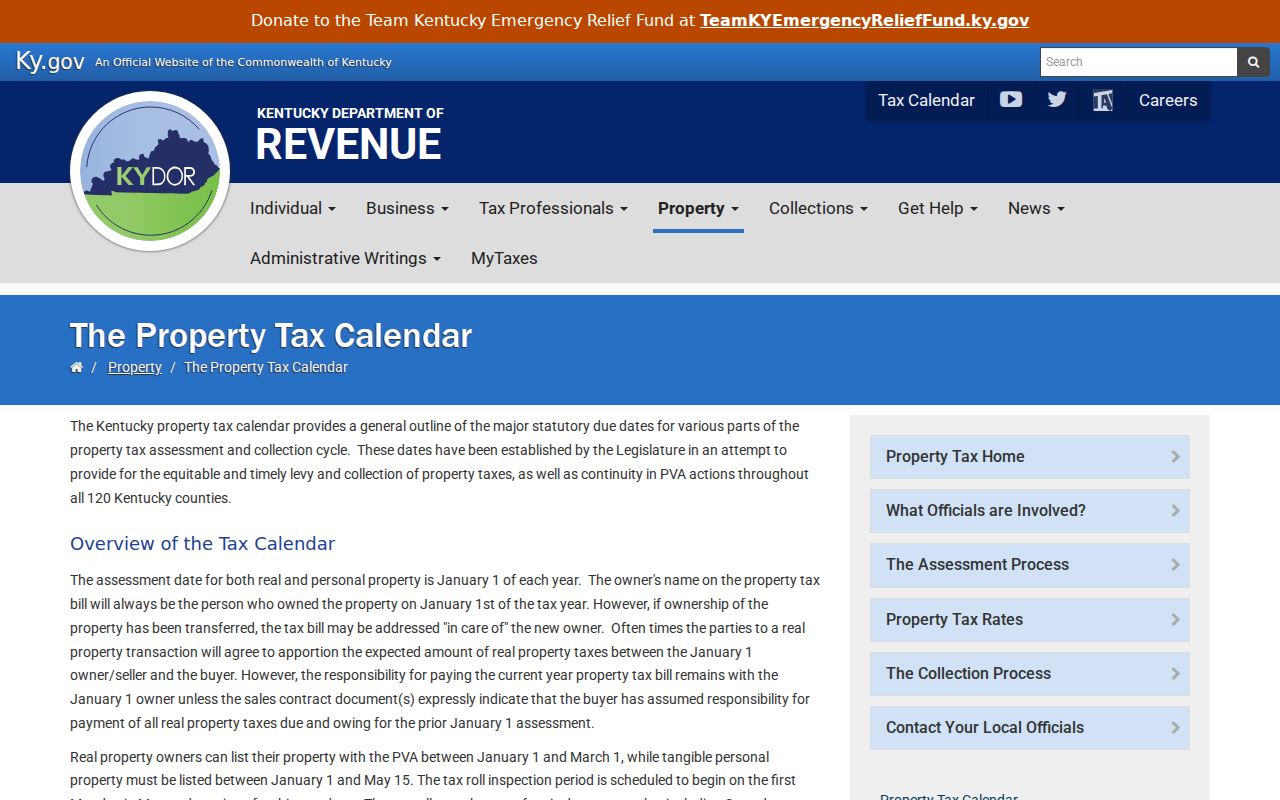
Pair the calendar with the Edmonson PVA’s local inspection notice. The statewide sequence never replaces the parcel-specific notice or local office instructions.
Note: Record the tax year, assessment date, inspection dates, and the date of every call or filing in the parcel file.
Look Up an Edmonson County Tax Bill
The county publishes no searchable treasurer tax-bill database. Start instead with the official PVA parcel identity, then ask the current county collection channel or office about bill status. The treasurer page offers a contact route. For certificates and sale notices after a bill goes delinquent, the Clerk’s delinquent-tax page is the source.
- Find the address in the PVA/qPublic parcel search and copy the APN, owner, and tax district.
- Ask the active tax-collection office for the current bill, payment status, and prior-year route using that exact parcel number.
- Compare taxable value and any exemption with the PVA record; do not infer either from the amount billed.
- If delinquent, inspect the County Clerk delinquent-tax notice and current sale materials.
- Fair cash value
- The price property would bring in a fair, voluntary sale under Kentucky’s assessment standard.
- Levy or rate
- The rate applied by a taxing authority; the PVA does not set it.
- Homestead exemption
- A statutory assessment reduction for a qualifying owner and property, applied through the PVA.
- Certificate of delinquency
- The county’s statutory record of unpaid property tax after the collection process advances.
Check the Homestead Exemption on the Roll
The Kentucky homestead exemption page lays out current qualification rules and the application route. The exemption amount is $49,100 for the 2025–2026 period. The amount changes over time. Confirm any figure on the Department of Revenue page before relying on it.
An exemption lowers taxable assessment. It does not alter the deed. It does not erase the parcel’s full fair cash value. It does not establish title. Check that the exemption appears on the right year’s PVA record. Ask the PVA about documentation and deadlines. Exemption data goes back to 1972, which is why long-run tax figures do not compare cleanly without adjusting for changing exemption amounts.
Follow Edmonson Delinquency Notices Year by Year
The County Clerk’s delinquent-tax page is the official starting point once a bill enters the certificate-of-delinquency and tax-sale process. The 2025 notice covered 2024 delinquencies. It named publication in Edmonson News/The Gimlet, bidder registration, and a September 16, 2025 sale. A 2026 notice is linked separately. Never reuse prior dates for a current search.
Open the newest notice and record the tax year, the owner of record as listed, the parcel or bill identifier, principal and additions, publication date, registration requirements, sale date, and status. A listed certificate is not a deed. Payments, assignments, redemption rights, notices, litigation, and later recorded instruments can all change the outcome. Read the current county instructions alongside the public notice page.
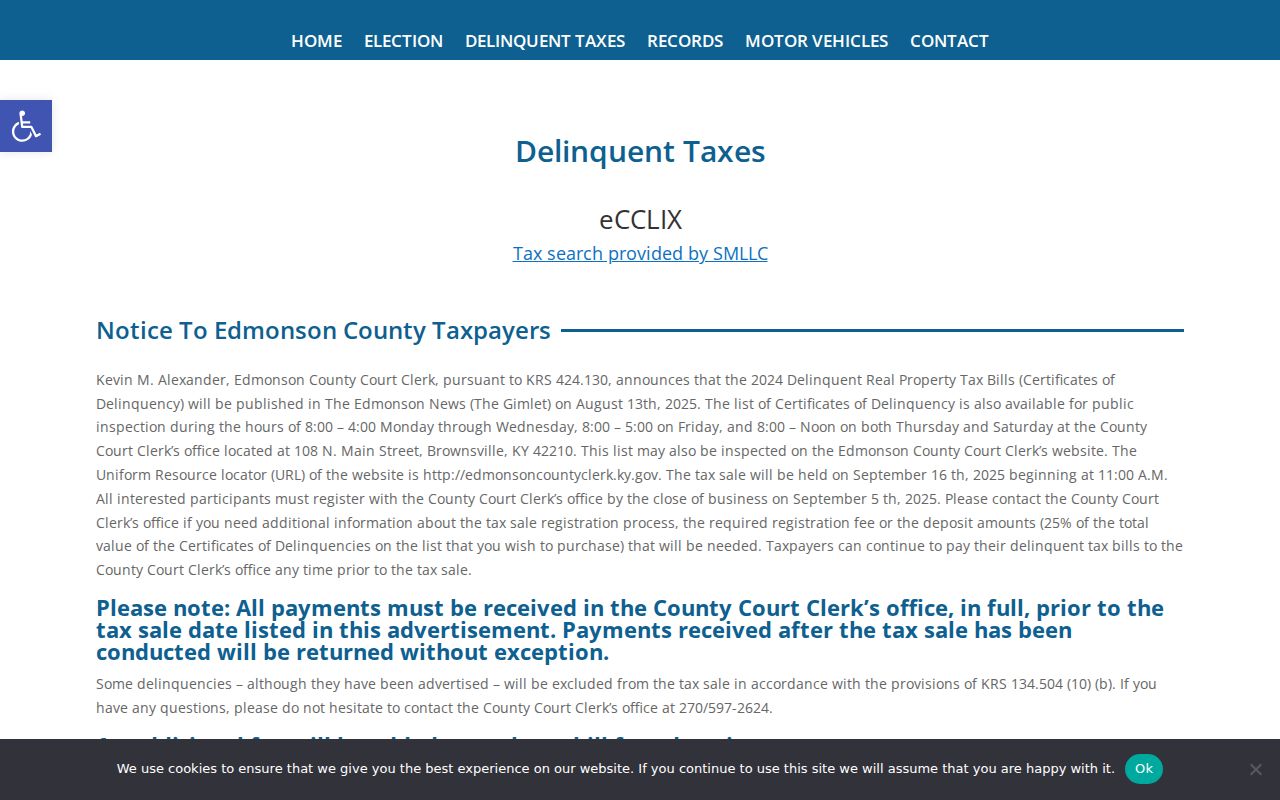
Treat the image as a route marker pointing to the live source, never a substitute for the newest PDF, parcel file, or clerk confirmation.
Older Edmonson Assessments Survive in Uneven Runs
The KDLA land-record inventory lists Edmonson assessment books for 1825–1831, 1833–1838, 1840–1875, and 1879–1892. It also covers 1950, 1957, 1969–1970, 1972–1977, and 1979–1981. Those broken runs can yield owner, acreage, classification, or value clues between deeds. Show the gaps honestly instead of silently filling missing years.
For access, the state microfilm guide and the KDLA Research Room are the fallback. A historical assessment entry shows how tax administration worked and points toward more records. It does not prove the named taxpayer held clear title.
Challenge an Edmonson County Assessment
Start with a conference at the PVA. Kentucky law sets this meeting inside the statutory real-property inspection period, so timing matters. Bring the parcel record, photographs, measurements, sale documents, repair estimates, and comparable-property information. Anything that corrects a factual error belongs on the table too. The goal is simple. Decide whether the dispute is about characteristics, classification, an exemption, or fair cash value itself.
An unresolved conference can move to the County Board of Assessment Appeals. That board follows its current local filing instructions. Kentucky's calendar requires the appeal no later than one workday after inspection closes. The Board usually convenes twenty-five to thirty-five days after inspection begins. A further appeal lies with the Kentucky Board of Tax Appeals. It must be filed within the period stated in the decision. Confirm every date and form for the current year before proceeding.
Appeal window. Do not substitute last year’s dates: complete the PVA conference and file with the Edmonson County Board of Assessment Appeals by the deadline in the current inspection notice.
Keep Edmonson Tax Evidence Separate from Title
A tax roll is not a title document. It ties an assessment account to a named taxpayer and parcel, but it conveys no land. A deed conveys the described interest. A bill reports a financial obligation, and a certificate of delinquency marks an unpaid tax stage. Compare owner names and legal-description clues carefully. Rely on the recorded deed trail when the question is who actually owns the parcel.
Postal geography sets a second trap. Brownsville is the county's only incorporated place. A 42210 mailing address can serve county land far outside the city. Never infer municipal taxes, zoning, or services from the postal city name alone. The tax district shown by the PVA and official boundary material control.
Build a comparison table across tax years. Give each year its own row. Put fair cash value, taxable value, land and improvement components, exemption, district, rate, original bill, additions, payment date, and delinquent status in separate columns. A jump in the amount due can stem from a valuation change, an exemption change, a rate change, or a district change. Accumulated charges can drive it too. The bill alone never says which input moved.
After a recent purchase, line up three dates. Compare the January 1 assessment status against the deed's execution and recording dates. Then compare the collection year printed on the bill. Those three dates often explain why a taxpayer name or value looks out of step with a closing. No official Edmonson source publishes a routine roll-refresh interval. Treat a mismatch as unexplained rather than erroneous until the PVA and the newest deed have both been checked.
Some tax questions reach beyond delinquent real-property tax. State and federal tax liens and their releases sit among the County Clerk's legal-record categories, searchable by debtor name. A general tax lien and a parcel-specific certificate of delinquency are different records entirely. Preserve the document type and any release or assignment history instead of collapsing every tax-related entry into one status.
Note: Preserve the source, retrieval date, tax year, APN, and office for every figure; otherwise similar numbers can describe different things.