
Read Edmonson County's Owner-of-Record Card
The Edmonson PVA qPublic application is the official starting point. The parcel card loads live in the portal. Capture the owner-of-record name, parcel number, and card date exactly as displayed whenever those fields appear.
| Owner name | Exact person, trust, estate, or organization named on the roll |
|---|---|
| Mailing address | Destination for tax correspondence; not proof of residence |
| Situs address | Physical property search key, which may differ from mailing geography |
| Parcel number | APN used to reconcile the card, map, and legal records |
| Last sale or deed reference | A lead to compare with the clerk's newest recorded conveyance, when displayed |
| Assessment data | Tax-administration context, not proof of title or occupancy |
The name reflects the owner of record on that day. The owner, occupant, taxpayer, and mailing recipient can all differ, so the card alone never establishes where anyone lives.
Know When the Edmonson Owner Record May Lag
No local source states a PVA refresh cycle. None publishes a closing-to-roll delay either. That gap matters. Never promise a sale will appear within a fixed number of days, because timing varies with recording volume. Date-stamp the PVA result. Then compare it against recording activity through that same date. A just-recorded deed can name a newer grantee before the assessment roll reflects the transfer, and a deed-index name match may instead involve another parcel, an easement, or a corrective instrument. Match the legal description, parcel clues, and party role before concluding anything.
Recent-sale gap. When the roll and latest deed conflict, treat the newest matching recorded deed as the more current conveyance source and ask the PVA about its update status.
Separate Edmonson Situs from Owner Mailing Data
The situs address describes the assessed property itself. The mailing address tells the PVA where to send tax correspondence. Treat the two as separate fields. A Brownsville label on either line needs context, because the 42210 postal zone reaches beyond the incorporated city limits. A mailing-city label alone never proves residency, city jurisdiction, or occupancy.
Kentucky deed law also requires mailing and in-care-of statements in covered conveyances. Compare them with the roll. Their purpose stays distinct. A remote mailing address can coexist with present ownership.
Note: Record the source field exactly, and never relabel a tax mailing recipient as the person living at the situs.
Verify a Current Entity or Estate Name
An LLC or corporation changes the task. Run the exact name through the Kentucky Secretary of State organization search to confirm entity identity. It also confirms filing context. Remember what a registered agent is. That person serves as a service contact. They are not necessarily the owner, occupant, controlling officer, or economic beneficiary of the land.
A trust may show only its trustee publicly. Estate transfers can involve a will, affidavit of descent, or survivorship. They can also involve an executor deed or a court order. Search recorded instruments, and use the Edmonson Circuit Clerk route where probate or title litigation matters. Keep fiduciary, beneficiary, heir, trustee, and grantee roles separate throughout.
Open the Edmonson PVA Owner Starting Point
The county-linked qPublic entry opens the parcel-search destination.
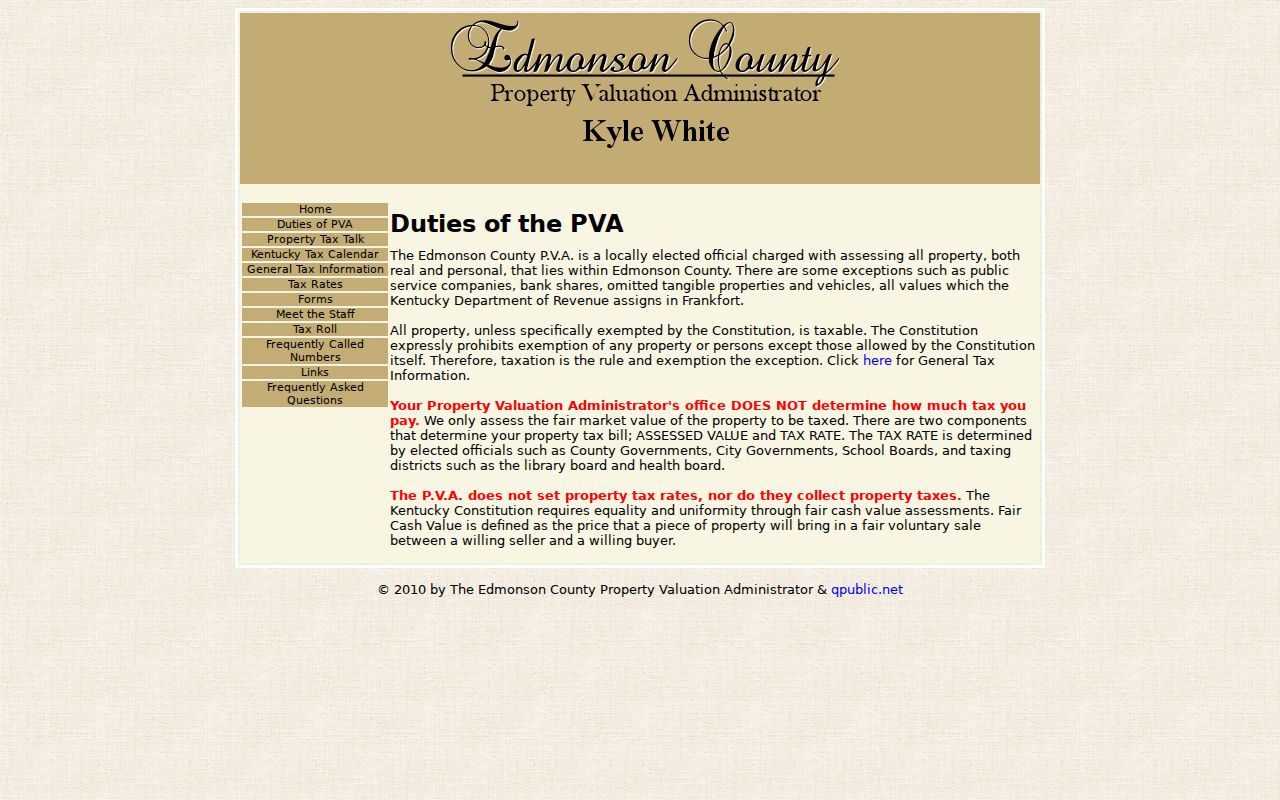
That view confirms the route only. Use the live application for the current record, and note only the fields it actually returns.
Use the Edmonson Counter When Online Results Are Thin
Pick up the phone when online results run thin. The PVA answers at 270-597-2381 whenever qPublic is down or a parcel-card field needs explaining. Deed confirmation goes through the County Clerk. Visit the office at 108 N Main Street in Brownsville. You can also call 270-597-2624. Published hours are Monday through Wednesday 8:00 a.m.–4:00 p.m. Thursday and Saturday hours run 8:00 a.m.–noon. Friday hours are 8:00 a.m.–5:00 p.m. Confirm them before traveling.
Office inspection of records and indexes is free. Private online users receive free Edmonson-only access limited to five searches per day. Bring the current owner spelling, alternative names, APN, situs, approximate transfer date, and any deed reference. Staff can then route the question efficiently.
Watch Future Owner-Name Filings with DocAlert
The clerk launched DocAlert locally in 2025. The service monitors deed and mortgage names for free. Enter a personal or business name and an email address. A notice arrives whenever a matching instrument records. That makes it useful once the current owner has been verified.
An alert signals a filing, nothing more. It is not an ownership change or a fraud finding, so retrieve the instrument and compare its party role, legal description, date, book and page, and signatures. Consult the clerk's current instructions rather than assuming the form's behavior.
Confirm Edmonson County's Current Owner
When the PVA snapshot and a recent transaction fall out of sync, turn to the newest recorded deed. That deed is the practical confirmation source for the current owner in Edmonson County.
- Search the situs and copy the PVA owner wording, mailing line, APN, and access date.
- Use the owner name and parcel's legal-description clues at the County Clerk Legal Records Department.
- Find the newest deed with a matching parcel description and read the grantee, recording date, and deed reference.
- Resolve a mismatch by checking corrections, affidavits, estate instruments, or court orders rather than choosing the preferred name.
- Owner of record
- The party named by an official property source on the date inspected.
- Assessment roll
- The PVA's tax-administration record, not a title opinion.
- Recording lag
- The interval between a deed being filed and another system reflecting the change.
Contact an Edmonson Property Owner Responsibly
A tax roll mailing address is meant for property correspondence, nothing more. The field may point to a manager, a fiduciary, or a post-office box. It may also name an owner living outside Edmonson County. Keep any written inquiry brief and tied to a legitimate property matter. Restraint still applies. Just because an address is public does not make publishing it responsible.
Write down an answer you can audit, not a bare name. A good current-owner note records the PVA access date, the exact owner wording, the APN, the situs, and the mailing field as labeled. Add any sale or deed clue on the screen. For confirmation, add the newest matching deed's grantee, grantor, and recording date. Add the book or instrument reference, plus a legal-description match. When sources disagree, say so plainly with the dates. Never merge conflicting records silently. That discipline matters most after recent closings, in estates, with parcel splits, and when family members share a surname.
Privacy programs and public-record law do not soften the obligation to act with care. Kentucky Safe at Home can substitute an address in certain public systems. Its compliance guidance carves out real-estate holdings as an exception. Treat that exception narrowly. Kentucky's Consumer Data Protection Act binds covered private controllers. It does not automatically pull a recorded deed from the custodian. Errors belong with the source office. That means the PVA for the roll, the County Clerk for instruments, and the Circuit Clerk for judicial orders.
What you want is a dated, source-specific owner answer. The public card cannot establish residence, personal relationships, finances, or actual control of the land. If title, boundary rights, inheritance, or competing claims are at issue, get qualified legal or title assistance instead.
Lawful use. A public owner record supports legitimate Edmonson County property contact. It does not authorize stalking, repeated unwanted contact, harassment, intimidation, or harm.