
Trace Edmonson County Former Owners by Transfer
Build the chain backward from the most recent recorded conveyance. Treat these names as roles, not results. Copy the transfer date from each real deed. Also copy the grantor, grantee, deed type, and the book and page or instrument reference. Edmonson County deed records reach back to county inception online. Most other instrument images start in January 1986, and mortgage images begin that same year. Coverage varies by record group. That uneven start date is why the citation matters as much as the image itself.
| Transfer evidence | Verified span | Custodian | Use in the backward chain |
|---|---|---|---|
| Newest deed and deed index | County inception to present stated online | Edmonson County Clerk | Grantor to grantee, date, legal description, and prior reference |
| Modern instrument images | Most types from January 1986 | County Clerk / eCCLIX | Images that verify the index citation and deed terms |
| Deed-book microfilm | 1825-2015 | Kentucky Department for Libraries and Archives | Older links, book/page images, and an archival cross-check |
| Tax-assessment books | Selected runs from 1825-1981 | KDLA | Owner, value, or acreage clues between deed links, not title proof |
For a recent chain, start with the County Clerk Legal Records Department. Online access is free but limited to Edmonson County and five searches per day. Inspection of public records and indexes at the office costs nothing. When a citation predates the available images, keep the exact book and page and take it to the clerk counter or to KDLA microfilm instead of stopping the chain.
The clerk's records page lays out the local coverage and access options for former-owner work:
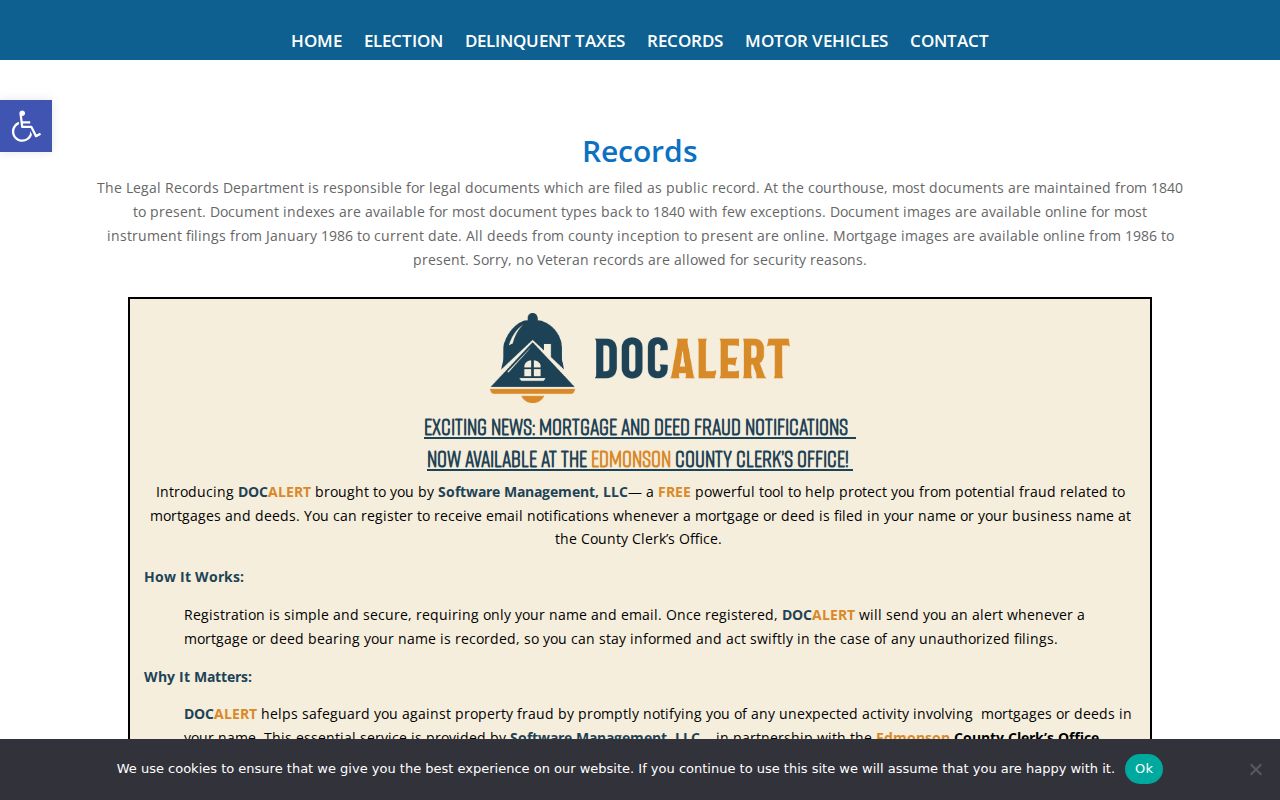
Deeds, mortgages, and other instruments each carry their own start date on that page. That split explains why an index entry can exist even when the expected image path changes.
Start the Edmonson County Ownership Timeline at the Newest Deed
Start with the current PVA parcel. Use it just to fix the address, parcel number, and owner-of-record name. Then search that name as grantee in the County Clerk deed index. Pick the deed whose legal description matches the subject land. Record the recording date separately from the deed date. Save any prior-deed reference too. It may point straight to the next older book and page.
| Transfer date | Grantor to grantee | Deed type | Book/page or instrument |
|---|---|---|---|
| Newest matched recording | Previous holder to current grantee | As indexed | Copy exact citation |
| Next older matched recording | Earlier holder to later grantor | As indexed | Follow prior reference |
| Repeat for each link | Keep party roles distinct | Note corrections or estate instruments | Preserve each citation |
A shared surname proves nothing. Match the parcel itself through the legal description, lot and block, acreage, adjoining-owner language, or a prior instrument reference. One deed can cover several tracts, and a single tract may later be split or replatted.
Note: The PVA roll is the starting clue; the recorded deed and matching legal description create each historical ownership link.
Edmonson County Deed Depth Crosses the 1986 Image Line
The County Clerk posts deeds from county inception to the present online. Most instrument images, though, begin in January 1986, and mortgage images start that year. The statements describe different record groups. A former-owner search in Edmonson County deed records should therefore keep index coverage, deed coverage, and scanned-image coverage separate. It should not lean on one date for everything.
Coverage boundary. A chain that appears to stop before 1986 may have reached an image cutoff, not the end of Edmonson County ownership records.
The in-person fallback is the Edmonson County Clerk at 108 N Main Street in Brownsville. Published hours run Monday through Wednesday, 8:00 a.m. to 4:00 p.m. Thursday and Saturday hours are 8:00 a.m. to noon. Friday hours run 8:00 a.m. to 5:00 p.m. Confirm hours before you drive over. Bring the party names and the citation. Ask for the grantor-grantee index or the deed book tied to that citation.
KDLA Microfilm Extends Edmonson County Former-Owner Research
The KDLA land-record inventory lists Edmonson County deed microfilm covering 1825 through 2015. It also shows discontinuous tax-assessment book runs plus wills from 1826-1992 and 1995-2015. Microfilm can bridge a missing image. It can check an old book and page. It can also surface an estate clue. Keep the inventory's printed gaps visible in your notes.
The Kentucky microfilm guide is the next route when an online image is unavailable:
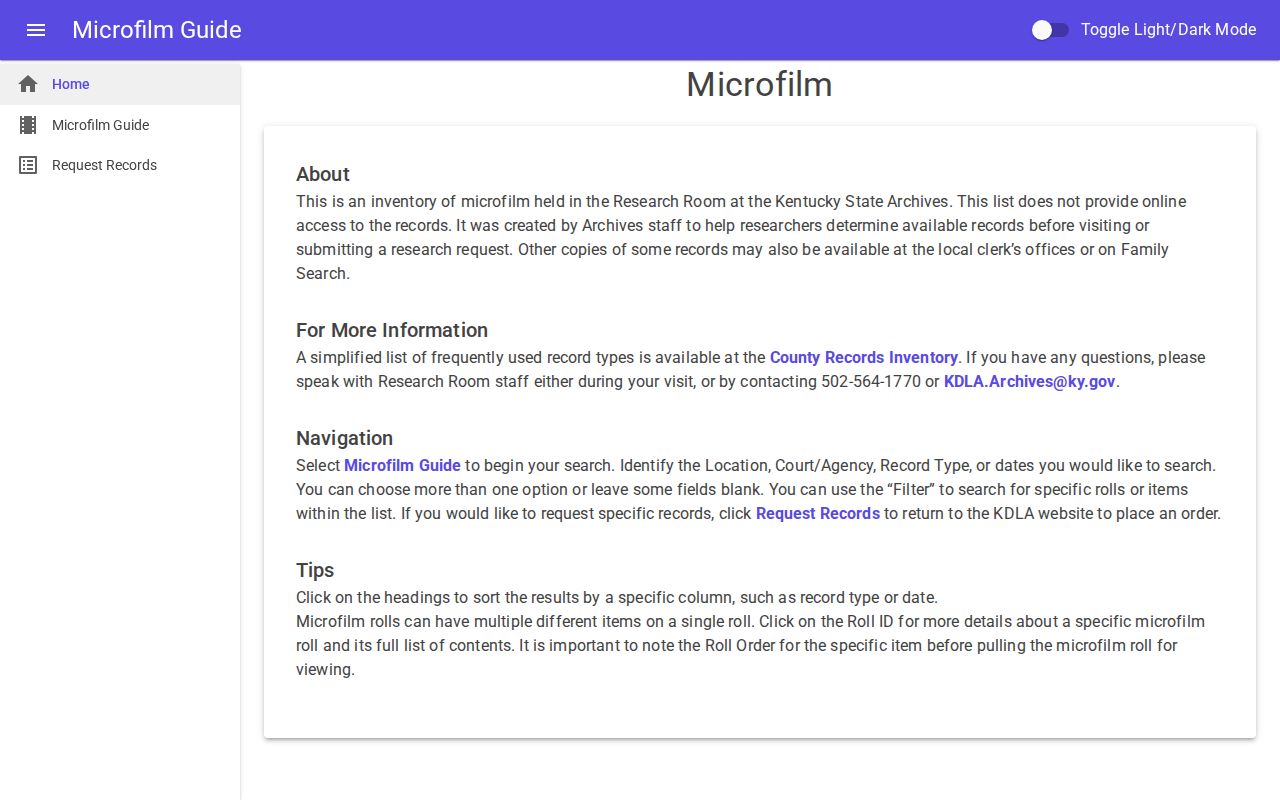
That guide rewards precise requests. Build one from the county, year, and record type. Add the party name and book and page. That beats asking for every deed under a common surname by a wide margin.
Researchers can also visit the KDLA Research Room at 300 Coffee Tree Road in Frankfort. Its holdings include deeds, wills, judicial files, and county records. Register and follow the handling rules. Bring the exact citations gathered from the modern index.
Reconstruct Edmonson County Previous Owners in Reverse
Read matched deeds in reverse chronological order. The current grantee's deed names the prior grantor, who then appears as grantee on an earlier acquisition. Party-name variations happen often. The land description still controls the match.
- Locate the newest matching deed with the current owner shown as grantee.
- Copy the grantor, recording date, deed type, legal description, and any prior book/page reference.
- Search that grantor as an earlier grantee, allowing initials, married names, entity suffixes, estate captions, and “et al.”
- Repeat the land-description check, then continue through the clerk's books or KDLA microfilm when an image is not online.
- Grantor and grantee
- The conveying party and receiving party named in a deed. The same former owner should appear in both roles at different points in the chain.
- Chain of title
- The ordered sequence of instruments affecting the same land, with each transfer supported by its own citation.
- Reverse index
- An index organized by grantee or receiving party, useful for finding how a later grantor acquired the property.
- Warranty and quitclaim deeds
- Different forms of conveyance. The label alone does not establish the quality or completeness of title.
Estate and Court Transfers Can Bend an Edmonson County Deed Chain
Not every transfer is an ordinary purchase deed. A death can produce several instruments. These include a recorded will, an affidavit of descent, an executor or administrator deed, a survivorship instrument, or a court-ordered sale. The County Clerk records wills and affidavits. A current probate file starts with the Edmonson Circuit Clerk. A beneficiary named in a will is only a lead. Record title passes through the recorder, not the will alone.
Search the decedent, estate name, spouse, heirs, executor, and administrator. Then compare the probate disposition against the same parcel description. A correction deed, partition, replat, split, merge, easement, or court judgment can create a branch. No surname list will reveal it.
For older cases, the KDLA judicial index supplies county, court, party, case, and accession clues. Current case-copy questions go through the Circuit Clerk at 110 E Main Cross Street. Judicial records travel the court route, not a routine Kentucky Open Records Act request.
Assessment Books and Newspapers Supply Edmonson County Owner Clues
KDLA catalogues Edmonson County tax-assessment books in scattered stretches. The runs cover 1825-1831, 1833-1838, 1840-1875, 1879-1892, 1950, 1957, 1969-1970, 1972-1977, and 1979-1981. An entry there can tie a name, acreage, or value to a spot. It helps where a deed link is missing. Treat each hit as supporting evidence only. An assessment never proves a conveyance, and the gaps between runs leave room for doubt. That caution matters when you rebuild an owner chain from property records.
The Edmonson County Public Library genealogy resources open a helpful door. They lead to Ancestry, FamilySearch, and a local newspaper archive. Digitized Edmonson titles run from 1927 to 2022 in several stretches. Estate settlements, tax sales, road names, subdivision announcements, and deed notices all surface there. Pull a name and date from a clipping. Then carry both back to the official deed books for confirmation.
Note: OCR can misread surnames and book numbers, so inspect the newspaper page image before using a result as a clerk-search lead.
Edmonson County Formation Sets the Earliest Local Search Boundary
Edmonson County was formed in 1825 from land taken from Grayson, Hart, and Warren counties. So the local property records simply do not reach earlier. A chain that bumps against 1825 may continue in one of those parent counties. First, though, the dated legal description must show which predecessor held the land. Searching all three and grabbing the first familiar surname builds a false chain fast.
One local legend also deserves skepticism. Some families blame a courthouse fire for missing papers. The KDLA courthouse-disaster table lists no destruction year for Edmonson. That absence proves nothing about survival. The fire story simply stands unsupported. It stays that way unless a specific source documents the lost record.
Brownsville Town Lots Add Names to Edmonson County House History
Brownsville's official history offers a remarkably concrete starting point for house research. Commissioners picked the Pt Pleasant tract in 1825. Those 100 acres were tied to Joseph R. Underwood and Stephen F. Logan. Sheriff John Rountree then sold the surveyed town lots over three days in 1828. The history reports prices from $9 to $114, with total proceeds of $5,248.29. Those figures make good search terms. They are not deeds.
For an old town parcel, feed terms like Pt Pleasant, Underwood, Logan, Rountree, Rhoads, Main, Washington, town lot, and original 100 acres into deed indexes and newspaper OCR. Each hit still needs checking against a deed-book page. Confirm every former owner of record against the evolving lot or street description, since Brownsville's parcels changed shape over time.
Note: When a Brownsville street search fails, switch to lot, block, legal-description terms, and original surnames before assuming the record is absent.
How Deep Edmonson County Ownership Records Reach
Edmonson County ownership records reach back to the formation era. The clerk states that deed coverage begins at county inception. KDLA lists deed microfilm starting in 1825. Most document-type indexes reach 1840, with some exceptions. Most modern instrument images, by contrast, start in 1986. A careful report says which layer supports each date. It never claims continuous images for every record type across two centuries.
When a backward chain hits the edge of the Edmonson County deed books, stop. Write down what you have. Record the last matched deed, the unresolved gap, and the source checked. Note spelling variants and any legal-description changes. A pre-1825 tract continues only in the correct parent county. A chain broken by probate or litigation needs its court case. It also needs the recorded follow-up instrument kept as separate evidence.
Lawful use. Edmonson County former-owner records support house history, estate work, and property diligence. They must not be used to track, intimidate, or harass a living person.